Sunday, April 24, 2016

Spring poles

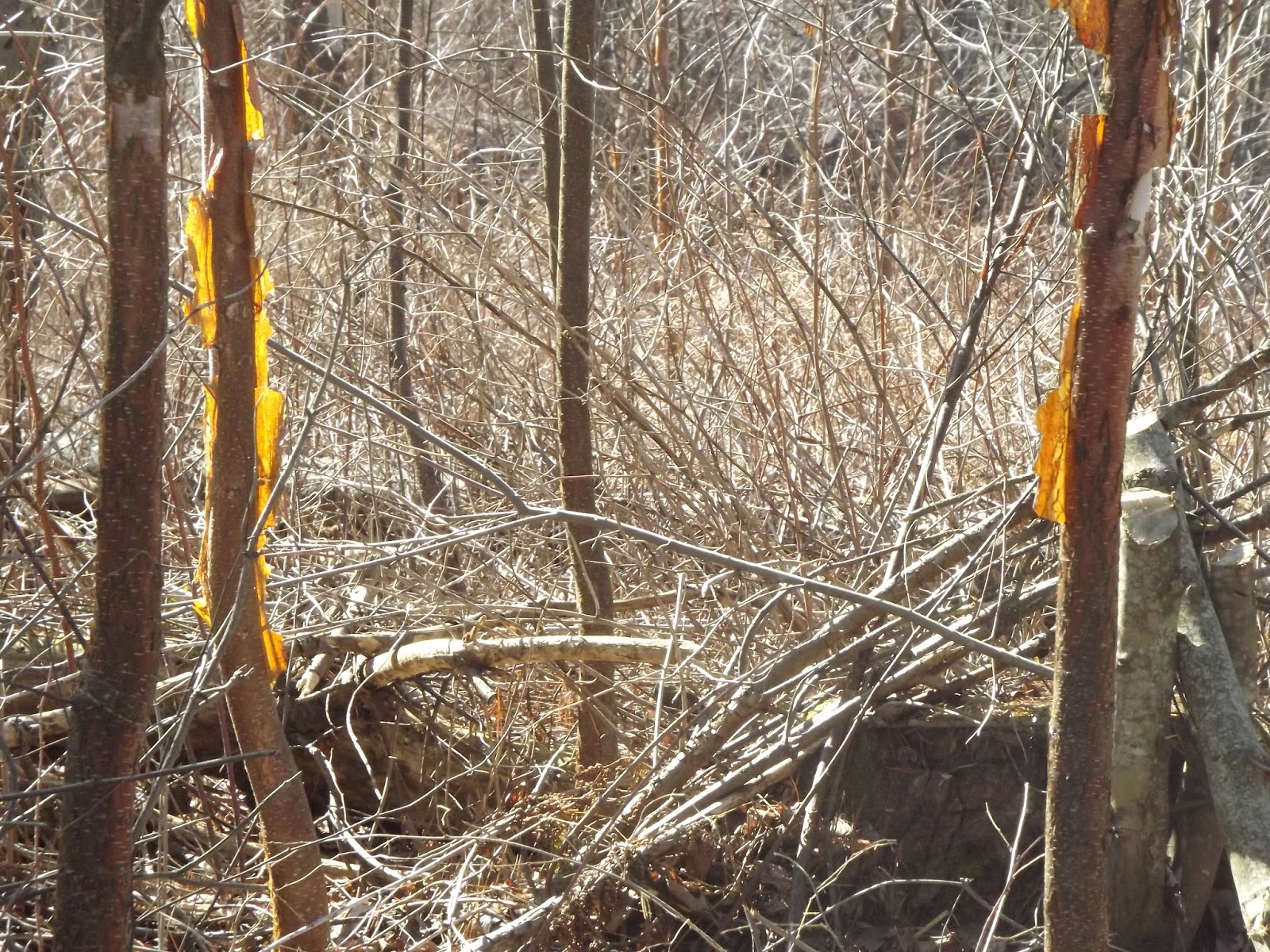
We cut down five spring poles on Saturday. Two yellow birch spring poles are pictured here. They are created when a tree bends and stays that way.
Spring poles create a lot of shade; branches on the top of the bend get a lot of sunlight and keep growing, even though the main truck does not. The tall branches on the first yellow birch in the photo above were probably 40 feet high. This shade from these useless branches means less growth for trees to the north that are still standing. That's why we cut spring poles. But you need to be careful. Much energy exists in the tree because the bend is so severe. You can't cut into the spring pole as you would a regular log. If you tried to, the bar and chain would get stuck rather quickly due to the massive amount of compression in the bent tree. So you must make small cuts and even shave off some of the wood on the inside of the spring pole. Then you can cut through to that point from the outer side of the bend. We were quite successful in our spring pole work. This is a pile of one yellow birch and one white ash spring pole. This was a different yellow birch than the two previously pictured.
Red maples frequently become spring poles. Their relative lightness can't stand up to some ice storms or strong winds.
On the way back up the hill, another busy woodpecker was spotted.

Thursday, April 14, 2016

Life enjoys the sun

We are in the second of what should be five sunny days. The panels are loving it! So is a busy woodpecker, working on a nest about 50 feet high (thanks to a broken white pine).
What a wonderful few days to be a shiny, happy, peeling young paper birch!

Sunday, April 10, 2016

16 megawatt/hours party

We are celebrating a very bright and shiny day. This was also the day we surpassed 16 megawatt/hours (16,000 kilowatt/hours) of production from our solar panels. Yesterday, we took the big saw into the woods for some cutting of broken or blown down future firewood. The wood (red maple and paper birch) was also split. After being taken to the area around the house, several of the pieces will be cut again. None of this wood will burn until the Fall of 2017. Here are pictures of the new wood.

Tuesday, March 29, 2016

Thinning followed by snow

The thinning in the birch grove promised three posts ago took place on Sunday. Black cherry was the primary casualty. Here's a picture of the bigger stuff in a pile this morning, with a fresh coating of "Still Wintah" snow.
Our little bit of snow today is falling in a fierce wind with temps allowing the wet flakes to stick on trees. Here's a shot from the eastern portion of the thinned grove. This shows the variety of color in Hardwood Hermitage bark.
Paper birch is whiter than normal thanks to the snow. Here's the grove's biggest example of the state tree.

Monday, March 21, 2016

Technically it is Spring, but in reality it is still Wintah!!!!

We started Spring off with 40kwh of solar production -- marking the first time we have had 40kwhs 2 days in a row! This makes us net-zero for the preceeding 5 weeks!!! ROCK OUT!!! The first day of Spring also marked the first day of chain saw work -- cut down a bending yellow birch, a small (ugly) black spruce, and cut up another black spruce tree that we'd cut down last year. This "cleans up" the terrace a bit. Our "river" is waffling between being liquid and ice --
Ice crystals still remained early Sunday on a little patch behind the wood shed on the south hill:
Two weeks ago, this creature and several of its pals stopped by for a quick snack. One was within a few feet of the screened in porch.

Tuesday, March 8, 2016

Of rocks and birches

The balmy wintah continues. A trace of snow yesterday led to discovery of what seems undoubtedly to be bear tracks. No pics of the bear (yet), but there's always birches. The first shows the panorama of a birch grove that will benefit from cutting in a few weeks.
Black cherry, which is a fine tree, will be cut out of the grove. Note the dark young trunks of the appropriately named tree. The species grows best farther south, so birches get the benefits when cherry is thinned up here. A quaking aspen and a few other less desirable trees are also doomed in this area.
A typical hardwood forest in northern New Hampshire. Note the red oak on the right, bigger paper birch, and yellow birch in the middle. Visible somewhat in the distance is a towering red maple.
Rocks and birches go so well together, don't they?

Thursday, February 18, 2016

15 megawatt/hours

Yesterday, the solar panels reached 15,000 kilowatt/hours of total production (15 megawatt/hours) since May 2013! For the entire month of February last year, thick snow covered the panels, so we had zero production. We'll easily pass 100 kilowatt/hours this month, thanks to the relatively balmy conditions. We're hoping to top 6,000 kilowatt/hours for the entire year.